


Sheila McCorkle VP of Legal and Regulatory for Space X, dismissively rolls her eyes at the concerns of Brownsville residents.
Possibly the only thing faster than the speed of light is the speed of business. Both Brownsville, Texas and Vermillion Parish have witness the rapid annexation of land by Space X within a matter of days notice. In Brownsville, its city commissioners were faced with a bargain, where it dis-annexed (releasing administrative authority) 444.45 acres of privately owned land within its city limits, and control of its port for 220 million dollars worth of admittedly desperately needed water infrastructure in the form of desalination and sewerage projects. Mayor of Brownsville, John Cowen Jr., said the proposal was brought to the city about a week and a half before the votes, rightfully outraging critics and residents who were only notified a mere 5 days before the votes.
Space X essentially used FOMO to speedily ink the deal, as its head of VP of Legal and Regulatory and resident of Starbase, Texas, Sheila McCorkle, only gave the commissioners 72 hours to make their final decision for a deal that would be a permanent transformation for the city of Brownsville. Vermillion Parish in Louisiana is a similar story. What had been rumored for months was only announced to residents of Vermillion Parish days before a deal has been inked after Exxon reached a settlement with the Exxons whose land Space X will be occupying and possibly purchasing.
Through arbitration between Exxon and the state of Louisiana, SpaceX then acquired the right to develop on Exxon's 125,000 acres with minimal notice to the Vermillion Parish residents and therefore little formal opposition. The tract would give Musk a strategic route connecting his operations in Florida and Texas, through the Intercostal Gulf Waterway, and access to the Chicot Aquifer (48% of Louisianans depend on this aquifer for water ).
SCOTUS ruling to Louisiana Windfall
The execution came after the recent Supreme Court ruling, Chevron v Plaquemines, mandating that environmental torts where government officers oversaw contracts had to be heard in federal courts.
The ruling affected 42 similar cases dealing with coastal land erosion and other environmental torts, 25 of which Exxon is a defendant, essentially freeing Exxon's 136,000 acres of land upon a settlement with the state of Louisiana.
Details of the settlement agreements have been hidden by a protective order from the associated federal judge. According to 38th Judicial District Court Judge Penelope Richard, the protective order will last “until final disposition of the coastal zone litigation, or until lifted by another order of this court.”
Confidentiality, Immunity, Generosity
Mark Schleifstein at The Times-Picayune wrote in regards to the confidentiality ,
“including the amounts received or paid,” with “their accountants, auditors, financial advisers, indemnitors, market analysts, the Securities and Exchange Commission, the Internal Revenue Service, and other necessary government entities,” who will be instructed to also honor the information’s confidentiality.”.
Confidentiality has been the anchor of economic development across the states as massive industrial facilities come online with virtually no public input. In Louisiana, this has been codified through legislation mandating confidential protection using NDAs regarding economic development agencies luring massive projects to Louisiana. Concerning Space X, not only has confidentiality been codified, but also immunity and tax-breaks.
The Louisiana Legislature unanimously approved House Bills 1088 and 1179, now Act 190 and Act 102, to create new state ad-valorem and sales tax breaks for equipment purchases and land development.
The tax benefits secured from the state of Louisiana include a payment in lieu of taxes of only 2% per year and up to 25 billion dollars in incentives and grants to Space X. Jack McFarland sponsored a bill that eventually became Act 101 that exempts aerospace facilities or activities from to the Public Records Law. Act 874 gives aerospace companies immunity from lawsuits for their most common tortious behavior; the bill states “no aerospace flight entity that owns and occupies a minimum of twenty thousand contiguous acres in this state shall be liable for any cause of action arising from nuisance, trespass, inverse condemnation, strict liability, or any other claim based upon noise, sonic booms, overflight, vibration, light, heat, exhaust, smoke, odor, visual intrusion, temporary access restrictions, or any other disturbance resulting from aerospace flight activities.”
This recent legislation is unsurprising, as SpaceX is dealing with a large number of lawsuits, maybe most notably in the U.S. District Court of West Texas for damaging 53 homes in South Texas from sonic booms and launch debris.
New Company Towns and total control.
Octavia Butler's ominously prophetic vision for America space telecommunication company dominating the American life with sprawling company towns , and people having to choose between living in a dying dystopia or enslavement to corporate masters.
The 2010’s marked an era of major tech companies completely changing the urban geographies and cultures of cities like Oakland, Austin, and Seattle. Massive companies moving into locales, bringing in a labor force that would buy cheap houses with inflated incomes and then gentrify. It wasn’t long til companies started making commitments, similar to the industrial paternalism of monopolies of yesteryear during the heyday of American coal and steel. Company towns like Meta’s Willow Village, Google’s Northbay Shore and relevantly Space X’s Starbase are only the twenty first century if the same 1800s dynamic.
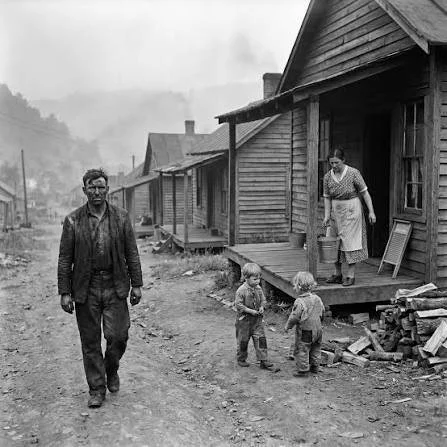
Gary Coal Shanty
Company towns are settlements completely controlled by a company that provides all the services the public usually would: housing, restaurants, social spaces, culture/entertainment, and even police. On the surface, they may seem harmless, but history shows otherwise. When wellbeing is at the whim of the private market, when employers control every aspect of their employees' lives, and when salaries given by companies are spent back on essential services, it resembles debt peonage not far from feudal servitude or sharecropping .
A blog from the Federal Reserve of Richmond sums up this phenomenon quintessentially.
“It is a tale of abundance and abandonment, boom and bust, plenty and poverty.”
And perhaps Engels provides one of the best first hand accounts through the eyes of a political theorist during the height of English imperialism in his 1845 “Conditions of the Working Class”.
There is plenty of evidence to show that company towns are notoriously responsible for sucking the resources from formal governments and establishing dependency just as the neocolonial economies of the post World War 2 era did to countries across the Americas , Asia and Africa. The status of labor monopsony, being the sole employer in an industry or locale, creates power dynamics not only between employers and employees, but also in the locales they live in.
During the late 1800s during westward expansion and the utilization of rail to grow the industrial economy, these corridors of workers were exploited to facilitate work, veritably and quickly. According to the Richmond Federal Reserve, the demand for “from 1850 to 1890, consumption of coal doubled every decade — and was responsible for the birth of Gary”. Gary, West Virginia, was the bedrock for U.S. Steel, a joint venture between two of the world's richest men, American magnates JP Morgan and Andrew Carnegie. Gary had no formal governing structure, as the superintendent of U.S. Coal was the de facto mayor and could readily evict workers. Similarly, Starbase has its own corporate governance, as employees of SpaceX, act as the de facto governors of Starbase. Eventually, due to the economic deindustrialization of the American economy, coal demand dropped by 28% from 1955 to 1960, and Gary saw a massive drop in its workforce. Given the AI market froth, the massive debt ratio driven by AI data center development, and the market risk exposure for the private credit industry, one can only think that a company whose core business model is built on artificial intelligence may be subject to the same fate. .
If this is the case, what risk could Louisiana be subject to given that SpaceX will be the monopsony driving growth in Vermillion Parish? Perhaps releasing Space X’s IPO at 100x its revenue wasn’t a good idea.
